

Rethinking Logistics: How are Cocoa Beans Transported?
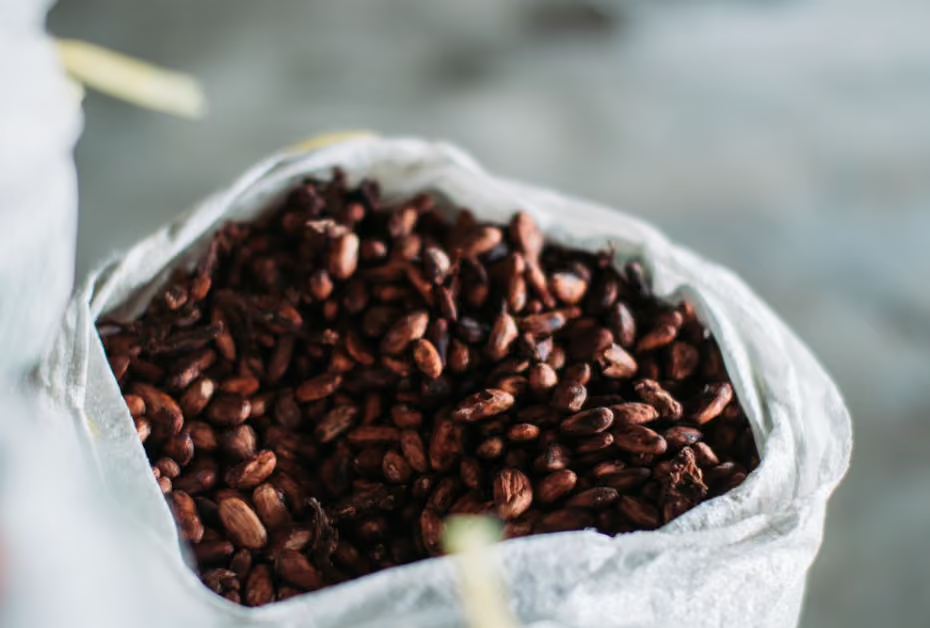
Cocoa prices are trading at record highs, and every rejected shipment now carries a financial cost that would have been unthinkable a decade ago. A single container of beans arriving with elevated free fatty acid (FFA) levels, mold contamination, or structural damage can trigger financial penalties, wipe out the shipment's margin entirely, or lead to outright batch rejection at the receiving facility. The most common cause of these outcomes is not upstream production error but downstream packaging failure, specifically moisture ingress and inadequate protection during transit through variable climate zones.
Compounding this commercial exposure is the fact that cocoa moves through one of the more challenging logistics environments in global commodity trade, a set of conditions that Goodpack has spent decades engineering its reusable steel infrastructure to address. Beans are handled dozens of times between harvest and receiving facility, crossing multiple modes of transport and climate zones that vary dramatically in temperature and humidity. Understanding how cocoa beans move through this journey, what happens at each stage, and where the packaging typically fails is the foundation for making cocoa logistics decisions that hold up under today's operational and commercial pressures.
Mapping the Cocoa Supply Chain: From Pod to Port
Each stage of the journey introduces specific opportunities for quality degradation, compliance friction, or sustainability liability, and these exposures compound across the chain:
- Production Stage: The journey begins on smallholder farms across West Africa, Latin America, and parts of Southeast Asia, where harvesting, fermentation, and drying set the upper limit on every downstream stage. With production spread across millions of farmers and thousands of cooperatives, this stage is both the source of the cocoa's commercial potential and the foundational documentation point for any meaningful traceability claim.
- Transfer to Primary Off-Takers and Warehousing: Beans move from individual farms to local buyers, cooperatives, or licensed buying companies before being consolidated at regional warehouse facilities and factories. Bag-handling practices, storage conditions, and documentation discipline at the warehouse level determine how much of the cocoa's original quality survives the transition from agricultural commodity to traded inventory.
- Transfer to the Ports: Inland movement from warehouse to seaport involves road transport across infrastructure that varies dramatically in condition, exposing the cocoa to temperature fluctuation, humidity ingress, dust, and physical handling stress. Peak harvest periods compound these risks by extending transit and pre-shipment storage windows beyond the conditions under which the original packaging was designed to perform.
- Departure From the Seaports: Cocoa ships in containerized vessels from West African ports embark on multi-week sea voyages that cross dramatically different climate zones. This final leg often determines whether a shipment arrives at premium grade or with quality penalties, as temperature swings, humidity buildup, and limited cargo visibility inside a sea container can compromise cocoa quality and increase the risk of spoilage or degradation.
The New Sustainability Stakes for a Vulnerable Commodity
Sustainability in cocoa logistics now reaches well beyond emissions, covering regulatory compliance, product integrity, packaging waste, and traceability, each with commercial, legal, and reputational consequences across every link in the supply chain. Organizations in the cocoa trade increasingly need to manage these areas as a connected whole, since a decision in one tends to shape the others.
The Regulatory Reset: EUDR and the New Era of Cocoa Compliance
The European Union Deforestation Regulation (EUDR) represents the most consequential regulatory development in modern cocoa trade. The regulation requires any company importing cocoa into the European market to prove that their product is fully traceable, and that it was not linked to deforestation after 2020. If a forest was cleared on 1 January 2021 or later, cocoa grown on that plot of land is permanently barred from the EU market, and non-compliance with the wider framework carries material financial penalties and the prospect of market access restrictions.
The deadline for larger operators to demonstrate compliance is 30 December 2026, extending to 30 June 2027 for micro and small enterprises.
Under the framework, producers and traders must now capture and retain geo-location data for every farm plot of origin, maintain an unbroken chain-of-custody documentation, and assemble audit-ready evidence that can be presented to regulators and downstream buyers on demand. Meeting this level of documentation requires new digital infrastructure and trained personnel, alongside a physical handling environment in which the paper trail stays intact alongside the cocoa it tracks.
The European framework is also part of a broader regulatory shift, with similar due-diligence rules emerging across the United Kingdom, the United States, and Asia-Pacific markets, each moving toward verifiable supply chain transparency as a baseline expectation. Organizations cannot meet these obligations through documentation alone, since the physical infrastructure moving the cocoa must itself support traceability and protect product integrity at every stage.
Protecting the Bean: How Packaging Determines Quality and Waste Outcomes
Cocoa beans and their downstream derivatives, including butter, mass, and powder, are high-value commodities whose quality must be carefully preserved throughout transit, and the performance of the chocolate produced from them depends largely on the condition in which they arrive. Maintaining these quality attributes directly influences commercial outcomes, affecting the cocoa's FFA profile, structural integrity, and microbiological condition upon arrival. The longer and more variable the journey, the more important the conditions inside the packaging become as a determinant of the cocoa's eventual grade and market value.
The most consequential transit risks fall into three categories, each carrying distinct commercial implications:
- Moisture and Free Fatty Acid Escalation: The more moisture the beans absorb in transit, the higher their FFA levels tend to climb. Excessive FFA pushes the flavor profile from pleasantly bitter toward rancid, triggering quality penalties, contractual disputes, or outright batch rejection at the receiving facility.
- Sustained Moisture and Mold Growth: Persistent moisture exposure creates the conditions for mold development on the beans, with cascading effects on grading, pricing, and contamination liability that can extend well beyond the immediate shipment.
- Heat and Cold Extremes: Heat exposure risks post-fermentation in raw beans and rancidity in fat-rich derivatives. Cold exposure can cause beans to fracture and lose the structural integrity that the receiving processor depends on for consistent yield.
Despite the well-documented sensitivity of the commodity, jumbo bags and other single-use formats remain the dominant packaging mode across cocoa supply chains, from origin warehouses in West African and Southeast Asian production zones through to processing facilities in Europe and beyond. Industry estimates place annual global usage at more than 45 million jute and polypropylene bags, each cycling through the supply chain once and generating packaging waste at every transfer point. These formats also offer only limited protection against the environmental factors that put cocoa quality at risk, a gap that prompted the European Coffee Federation and European Cocoa Association to issue a new joint industry specification for jute bags in late 2025, explicitly replacing the 1998 standard on the grounds that it no longer adequately controlled mineral oil contamination in food-contact packaging.
Goodpack: Engineering Reliability Into the Cocoa Supply Chain
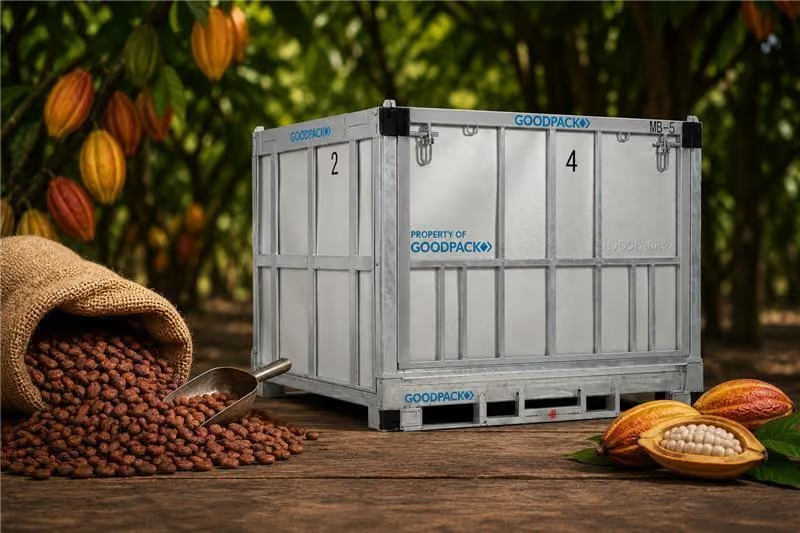
Across the cocoa industry, organizations that have moved beyond the limitations of jumbo bags and other single-use formats are converging on the same answer: replace the format altogether with infrastructure engineered specifically to protect product integrity, support traceability, and eliminate packaging waste in one coordinated solution.
Goodpack's steel intermediate bulk containers (IBCs) are engineered around exactly this principle. Three properties define the container: non-porous galvanized steel that resists moisture and cross-contamination, high-strength frames built for multimodal handling, and full liner compatibility tuned to the sensitivity profile of beans, butter, mass, or powder.
Each property maps to an outcome that matters at receiving: protected FFA levels and microbiological condition, preserved grading and pricing, and reduced batch rejection driven by handling variability.
The credibility of this approach within the cocoa industry specifically is reflected in our existing partnership with the Cocoa Association of Asia, which signals that Goodpack's role in cocoa logistics is recognized at the industry-association level. The partnership reflects an alignment between the operational requirements of the cocoa trade and the engineering choices embedded in our container fleet, providing industry-level validation.
For cocoa producers, traders, and processors, Goodpack's IBC packaging solution fits into existing operations at the packaging replacement point in the supply chain, taking the place of jumbo bags or single-use totes across the origin, warehousing, port, and receiving stages. Organizations lease containers as needed rather than purchasing them outright, and we manage collection and return through our global network of 5,000 delivery and collection points across more than 73 countries, with each unit cycling back into service after inspection rather than being disposed of after a single use. This shifts the packaging decision from a recurring per-shipment procurement transaction to a coordinated infrastructure choice, aligning compliance, quality, and sustainability outcomes with the day-to-day operational reality of the cocoa trade.
To learn more about Goodpack's partnership with the Cocoa Association of Asia, read our LinkedIn announcement here.
Format by Format: How Goodpack Compares to Traditional Cocoa Packaging
The case for Goodpack is best understood in the context of what the alternatives actually deliver in practice. The table below compares them against jumbo bags, wooden cases, and drums across the dimensions that most directly shape cocoa logistics performance.
Securing Cocoa's Future Through Resilient Logistics Infrastructure
The structural pressures now defining the cocoa industry are not transitional. They represent the new operating baseline against which every commercial decision in the cocoa trade will be evaluated for the foreseeable future.
Sustainable industrial bulk packaging offers a strategic answer for organizations seeking to operate modern cocoa logistics at scale. It allows regulatory documentation to flow through a controlled, standardized infrastructure, preserves product quality across long and variable transit corridors, and eliminates packaging waste by design, rather than as a target pursued incrementally.
Organizations that adopt durable, traceable, professionally managed packaging today are insulating themselves against future compliance costs, batch rejection losses, and the reputational risk of operating high-waste supply chains. By aligning your cocoa logistics strategy with IBC rentals and a trusted logistics partner, your organization can thrive in the cocoa industry's new operational reality.
For organizations ready to move beyond single-use cocoa packaging, Goodpack offers a durable, cost-efficient, and compliance-ready alternative built for the operational realities of modern cocoa trade. Get in touch with our team to assess your current transport process and estimate the potential reduction in packaging waste, handling damage, and carbon emissions across your supply chain.
Ready to optimise your cocoa supply chain?
Speak with our experts: www.goodpack.com/contact-us


