

Sustainable Transport Packaging: What It Is and How to Get It Right
Sustainable Transport Packaging: What It Is and How to Get It Right
Sustainable transport packaging is usually approached as a material question: Find a lower-impact format, substitute it into the specification, record the reduction. That framing accounts for one of the three variables that determine whether the change actually holds. For reusable transport packaging to deliver its intended economic and environmental value, three things need to work together: format, ownership model, and the return network. A reusable container only earns its cost advantage across the trips it completes, and completing trips depends on the return network rather than on the container itself.
That distinction is increasingly important. The EU Packaging and Packaging Waste Regulation has applied across all 27 member states since 12 August 2026, with quantified reuse obligations for transport packaging arriving on 1 January 2030. At the same time, freight costs, supply-chain disruption and the growing pressure to reduce packaging waste are pushing companies to look beyond one-way packaging decisions.
What Is Sustainable Transport Packaging?
Sustainable transport packaging refers to the packaging that moves goods through the supply chain, designed and managed to minimize waste across its working life. The category covers reusable formats designed for many trips, recyclable formats recovered at end of life, and reconditioned formats returned to service after repair. What these approaches have in common is that performance is assessed across a lifecycle rather than a single shipment.
At the tertiary layer, that performance standard is demanding. Industrial transport packaging needs to perform under demanding conditions. It may carry large volumes, move across multiple modes of transport, undergo repeated handling, and protect payloads where damage or contamination can be costly.
The contrast with single-use formats is structural. A single-use format is specified once and consumed once, so its cost recurs with every shipment and its waste accumulates in direct proportion to volume. A reusable format is spread across many trips, which shifts the economics from consumption to utilization and makes the return journey as commercially significant as the outbound one.
Common Types of Sustainable Transport Packaging
The available formats differ less in environmental intent than in the operating conditions they can withstand. Selection comes down to payload characteristics, handling intensity, and how far the packaging has to travel before it can realistically be recovered.
Reusable Packaging Systems
Reusable transport packaging comes in a range of formats, each suited to different payloads and supply-chain conditions. The right choice depends on factors such as payload characteristics, handling requirements, transport mode, storage needs and the practicalities of returning the packaging for reuse.
Durability, standardization, and stacking efficiency separate the categories more reliably than sustainable material choice on its own.
Format is only half the decision. Ownership is the other half, but often receives less attention. Pooling resolves this by placing the asset with a provider that maintains the fleet and operates the recovery network, while the user pays for access rather than the containers themselves.
The practical effect is that reuse stops depending on an organization's ability to retrieve its own containers from wherever they happen to end up. Inspection, repair, cleaning, and redeployment become the provider's responsibility, carried out at scale across a shared fleet. Utilization then scales with actual volume rather than being capped by whatever quantity was purchased in a given budget cycle. For organizations shipping across borders, that difference can determine whether a reuse system functions as designed or quietly reverts to single-use whenever recovery proves inconvenient.
Waste-Reduction Packaging
Lighter-weight tactics work alongside reusable systems:
- Reusable stretch wraps and strapping reduce consumable film volumes on palletized loads.
- Recyclable void fill replaces expanded plastics with recoverable material.
- Right-sizing, matching packaging dimensions to the actual load, reduces the empty space being shipped, which lowers both material consumption and the freight cost of transporting unused volume.
Each of these is incremental on its own. Applied consistently across a high-volume operation, they compound, and they reach the packaging layers that reusable formats leave untouched.
Why It Matters: The Business and Environmental Case

The case for sustainable transport packaging extends beyond environmental impact. Packaging decisions can also affect procurement costs, logistics efficiency, waste management and operational resilience, bringing sustainability considerations increasingly into procurement and logistics planning.
1. Waste Reduction
Each trip a reusable container completes is one more shipment that does not require a single-use unit to be manufactured, filled, shipped, and discarded. Across high-volume transport lanes, those avoided units accumulate quickly, and the volume of packaging material consumed falls with them.
None of this depends on separate initiatives or offsets. Waste reduction is built into the operating model itself: Packaging is recovered and returned to circulation rather than replaced after every shipment.
2. Cost Efficiency
Single-use packaging costs scale directly with shipment volume. Reusable packaging changes that relationship because the same asset can complete multiple trips. That is why the two positions diverge over time rather than at the point of purchase, and why a comparison drawn on unit price alone will consistently favor the more expensive option.
The relevant measure is total cost of ownership, which takes in unit price, disposal, handling and other operational costs that can all influence the economics of single-use packaging, particularly as shipment volumes increase. None of these appears cleanly on a single line item, and all of them scale with volume.
Leasing addresses the capital question separately. It removes the upfront investment from the equation and aligns cost to actual usage, which suits operations whose volumes move seasonally, by contract, or by harvest cycle.
3. Regulatory Drivers
The PPWR provides the clearest timeline currently in force. From 1 January 2030, at least 40 percent of transport packaging used within the EU must be reusable within a managed reuse system. From 2040, economic operators are expected to endeavor to use at least 70 percent of these packaging formats in a reusable format within a reuse system.
Stricter reuse requirements apply to certain movements: transfers between sites of the same company or its linked and partner enterprises, as well as business-to-business deliveries within a single EU Member State.
Extended producer responsibility (EPR) makes producers accountable for the end-of-life management of the packaging they place on the market. Under the PPWR, recyclability performance will increasingly determine the EPR fees its producer pays, making recyclability and end-of-life performance a direct commercial factor in packaging design.
4. Supply Chain Resilience
Repeatedly purchasing packaging leaves businesses exposed to input prices. Timber, resin, and corrugate move with markets that have no relationship to the goods being shipped, and shortages tend to arrive without useful notice. A reusable fleet already in circulation can reduce that exposure by reducing the need to procure new packaging for every shipment.
Standardization adds a second layer of stability. A container engineered for long-term multimodal use performs predictably when routing changes, storage windows extend, or loading timelines compress, which is precisely when single-use formats introduce the most variability.
Closed-Loop vs. Open-Loop: Choosing and Running the Right System
Reuse only works if the packaging comes back. How it comes back depends on the structure of the supply chain, and that can influence whether ownership, leasing or pooling is the most practical model.
Closed loops can make ownership practical. When routes repeat and volumes hold steady, a purchased fleet can be cycled internally without much overhead, and the asset stays inside a boundary the organization controls.aa
Open loops require a different approach. When containers move across customers, ports, and regions, the challenge shifts from simply owning the packaging to ensuring that it can be efficiently recovered and returned to circulation.
Format still has to match the payload, and requirements diverge more between industries than the category label suggests:
- Automotive flows prioritize component protection and just-in-time sequencing.
- Non-hazardous chemical movements prioritize structural integrity across long multimodal legs.
- Bulk food ingredient operations carry their own cleaning and inspection standards, which raise the bar on what a shared asset pool must demonstrate before its containers qualify.
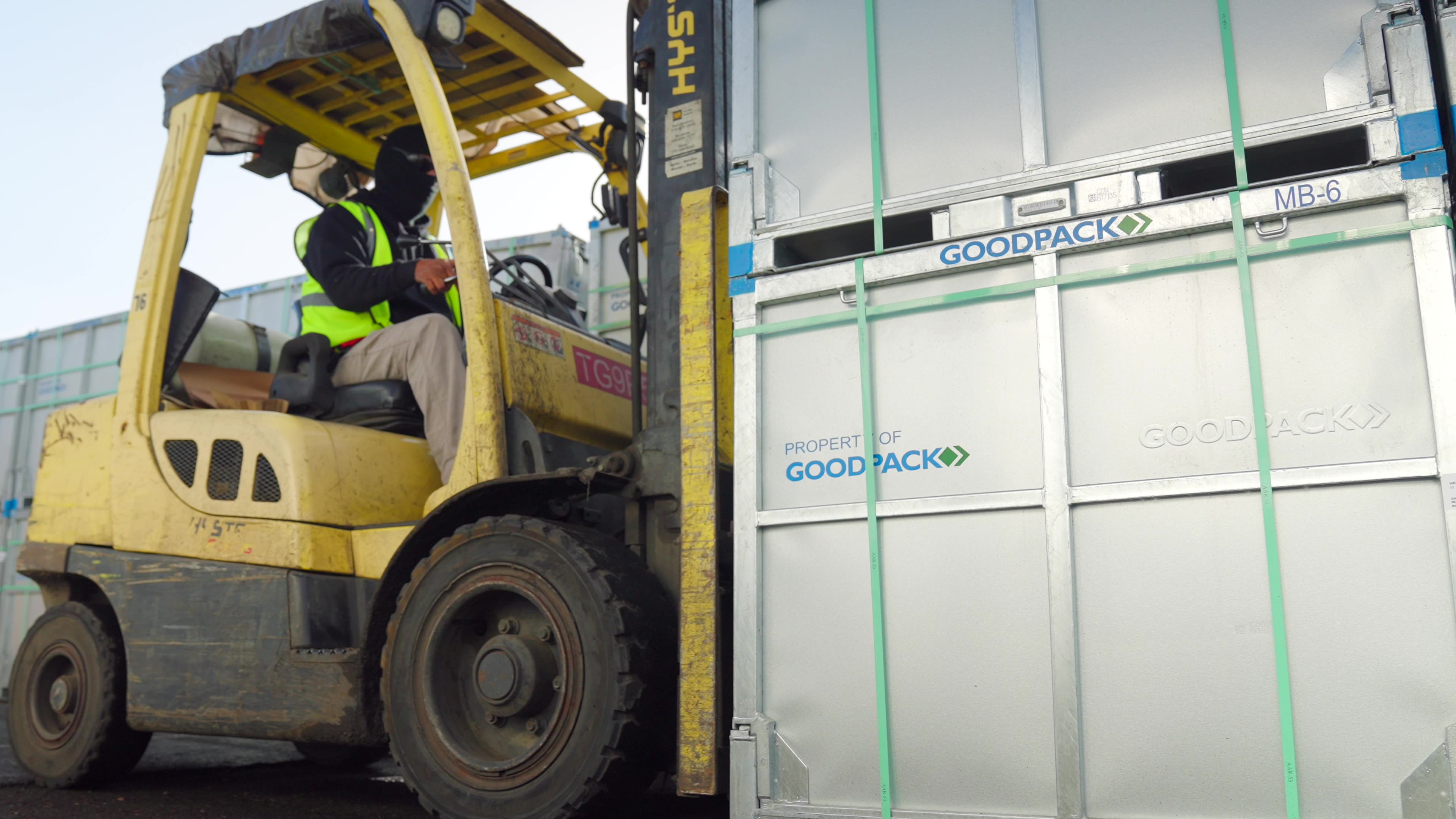
Our leasing model was built for open-loop conditions. Organizations leverage a reusable intermediate bulk container solution rather than purchasing and maintaining a fixed fleet of their own, drawing on Goodpack's galvanized steel containers and more than 5,000 delivery and collection points across 73 countries. Containers are returned through that same network, inspected, and redeployed, a cycle that has run for more than 30 years and now puts 5.1 million containers into global circulation. RFID tags give customers visibility over how many are in transit, in a warehouse, or awaiting return, which is the aggregate picture reuse reporting calls for.
Making the Shift: What to Look for in a Partner
When evaluating a reusable packaging partner, the network deserves as much attention as the container itself, because it is what determines whether the container performs its second trip and every one after it.
- Network coverage that aligns with your shipping corridors and supports recovery at destination
- Asset durability measured in years of service and trip counts achieved, rather than in nominal specification
- Fleet visibility technology capable of asset tracking, utilization monitoring and reuse data collection
- Reverse logistics capability, including who arranges collection, who bears the cost of empty movements, and who carries responsibility for inspection and repair
- Industry-specific experience with payloads comparable to your own, given how substantially handling requirements differ between sectors
Goodpack fits this model by design. We bring the IBC rentals, network, and the recovery cycle together in a leasing model. This integrated approach supports the recovery and continued circulation of reusable packaging across complex, cross-border supply chains.
The Direction of Travel Is Already Set
Regulatory thresholds are dated, material costs keep moving, and customer expectations on supply chain transparency are increasingly written into contracts rather than raised in conversation. What remains open is how much of the transition happens on your timeline rather than someone else's.
If you are assessing your packaging portfolio against the 2030 reuse threshold, send our team the corridors you ship on and the payloads you move. We will map which of them our existing network already covers, and what a sustainable industrial container solution would look like across them. Contact us today.


