

EU Packaging Mandates: Navigating the PPWR
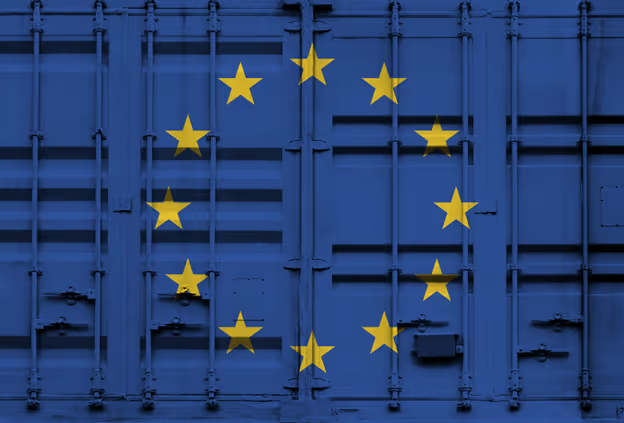
EU Packaging Mandates: Navigating the PPWR for Supply Chain Resilience
The management of packaging in Europe is entering a decisive new phase. With the introduction of the Packaging and Packaging Waste Regulation (PPWR), sustainability expectations are shifting from voluntary commitments to enforceable, system-wide requirements. For manufacturers, logistics providers, and brand owners supplying into the EU, this is not simply a regulatory update. It is a structural change in how packaging is designed, sourced, used, and recovered across the supply chain.
While full implementation may still feel some distance away, the direction of travel is already clear. The EU is accelerating toward a circular economy model that places accountability on the entire lifecycle of packaging. For organizations that rely on global and often complex logistics networks, now is the time to assess where current packaging models may create rigidity, cost exposure, or compliance risk in the years ahead.
What is the Packaging and Packaging Waste Regulation (PPWR)?
The PPWR introduces a single, harmonized regulatory framework to overhaul how packaging and packaging waste are managed across the European Union. Unlike the previous EU Packaging Directive (94/62/EC), which was transposed differently by each member state, the PPWR applies directly and uniformly. This removes much of the fragmentation that has historically complicated cross-border logistics and compliance.
For companies operating across multiple EU markets, this harmonization is significant. It creates one set of rules, one compliance baseline, and a clearer line of sight on future obligations. Many of the core measures are expected to apply from 12 August 2026, making the next few years a critical window for reviewing packaging portfolios and stress-testing them against durability, reuse, and recovery requirements.
Core Strategic Objectives of the PPWR
At the heart of the regulation is a clear objective: to decouple economic activity from the growth of packaging waste. In practical terms, this means moving away from linear, disposable models toward packaging systems designed for efficiency, reuse, and material recovery. The PPWR sets out several strategic pillars to support this shift:
- Mandatory Quantitative Reduction: Member states are required to reduce the amount of packaging waste generated per capita, placing pressure on businesses to avoid unnecessary material use.
- Enhanced Recycling and Post-Consumer Recycled (PCR) Content: The regulation strengthens recyclability requirements and introduces minimum PCR content thresholds for plastic packaging to support the secondary materials market.
- High Environmental Compatibility: Packaging must be designed so it does not hinder recycling processes or contaminate other waste streams, reinforcing the importance of material choice and design simplicity.
- Standardized Lifecycle Transparency: Improved data collection and reporting are intended to give regulators greater visibility over how packaging performs across its full lifecycle, from placement on the market to end-of-life.
Together, these objectives signal a clear expectation: packaging decisions will increasingly be judged not just on cost or availability, but on long-term environmental performance.
Navigating the PPWR: Strategic Considerations for the Industry
.avif)
Aligning with Recyclability and Eco-Modulation
One of the most immediate challenges under the PPWR is meeting stricter recyclability criteria. The regulation introduces escalating recyclability thresholds, starting at 70% by 2030 and increasing to 80% by 2038. Packaging that fails to meet these standards risks restrictions or higher compliance costs.
From a strategic perspective, this shifts attention toward materials that are already well-established within circular systems. In alignment with EU standards, Goodpack utilizes galvanized steel, a material that can be recycled infinitely without loss of quality. While plastic solutions eventually degrade, our metal IBCs are designed for longevity, successfully shifting the supply chain model from consumable to durable asset.
This material choice also matters under emerging eco-modulation schemes, where extended producer responsibility (EPR) fees are adjusted based on the environmental profile of packaging. Highly recyclable and durable formats, such as steel, are positioned to benefit from lower fees over time. In contrast, packaging that relies heavily on hard-to-source PCR plastics may face cost volatility and quality constraints. By utilizing IBC packaging solutions built around durable steel structures, Goodpack offers a more stable compliance pathway that ensures long-term predictability without compromising product protection.
Reducing Waste Through Minimization and Void Space Control
Waste prevention under the PPWR goes beyond material selection. The regulation places increasing emphasis on packaging minimization, including limits on unnecessary empty space within transport packaging. By 2030, empty space is generally expected not to exceed 50% of a packaging unit, shifting the burden of proof onto companies to justify inefficient designs.
For many traditional packaging formats, meeting this requirement can mean redesigning internal dunnage, adding bespoke inserts, or increasing packaging complexity. By contrast, standardized steel IBCs offer a more streamlined solution. Engineered for high load density and structural strength, they provide maximum protection through their outer frame alone. By eliminating the need for secondary void fillers, Goodpack’s design maximizes load density while stripping away unnecessary packaging waste.
This approach addresses minimization requirements at their root. By maximizing payload efficiency and reducing unused volume, companies can improve transport efficiency, lower emissions per unit shipped, and demonstrate compliance without extensive redesign efforts.
Simplifying Reuse Through Pooling
Reuse is a central pillar of the PPWR, but implementing reuse systems at scale can be operationally challenging. Tracking assets, managing returns, and reporting reuse rates across borders require robust systems and processes. For many organizations, this administrative burden is a key barrier.
For global supply chains, pooling modelsoffer a practical solutio. By integrating with ashared asset network, companies can access reusablepackaging withoutassuming fullresponsibility for ownership and reverse logistics. Goodpack’s globalpooling system manages collection, inspection, and redistribution as part of aservice, allowing reuse to function reliably across regio
Underpinning this physical network is a robust digital framework. RFID-enabled IBC rentals and tracking platforms provide the visibility needed for operational control and regulatory reporting. By automating transparency, we allow procurement and supply chain teams to move beyond administrative compliance and focus on what matters most: continuity, cost, and performance.
Future-Proofing the Supply Chain: From Compliance to Circular Advantage
The PPWR marks a clear departure from Europe’s historical reliance on disposable packaging models. Navigating this new landscape requires more than just incremental adjustments; it demands a more fundamental reassessment of how packaging assets are selected, deployed, and valued throughout their lifecycle.
Durable, reusable systems offer a direct route to managing this transition. By embedding circularity into their core packaging strategies now, companies can mitigate regulatory risk, stabilize long-term costs, and strengthen supply chain resilience. Standardized, reusable assets, such as galvanized steel IBCs, bridge the gap between high-level sustainability goals and day-to-day operational efficiency.
As EU packaging regulations continue to tighten, proactive adaptation provides a strategic advantage. Businesses that act ahead of enforcement deadlines will do more than just maintain compliance; they will secure market access, maintain operational flexibility, and lead the way in meeting the growing expectations of regulators, customers, and stakeholders alike.
References
European Commission. “Packaging Waste.” Environment.ec.europa.eu, environment.ec.europa.eu/topics/waste-and-recycling/packaging-waste_en.
“PPWR:The Packaging and Packaging Waste Regulation Explained.” DSSmith.comCorporate, 2019,www.dssmith.com/media/our-stories/2024/5/ppwr-the-packaging-and-packaging-waste-regulation-explained.
“WhatIs the PPWR and When Does It Come into Force?” Fkur.com, 2025,fkur.com/en/knowledgebase/ppwr-eu-packaging-waste-regulation/.


