

What Is Packaging Pooling? Models, Benefits & Providers

Many manufacturers purchase and manage their own transport packaging, taking responsibility for storage, maintenance, repair and end-of-life management throughout its service life.
Packaging pooling solutions offer an alternative. Instead of owning a dedicated packaging fleet, businesses access reusable transport packaging through a managed shared network. The pooling provider manages the assets throughout their lifecycle, including supply, collection, inspection, maintenance and redistribution.
Two pressures have moved the model from a niche logistics arrangement toward a mainstream procurement question. Capital considerations have also encouraged businesses to evaluate alternatives to maintaining dedicated packaging fleets, while reuse and waste-reduction mandates under frameworks such as the EU Packaging and Packaging Waste Regulation (PPWR) have shifted the focus to reusable alternatives.
Understanding how pooling works, the different models available and the capabilities required to operate an effective pooling network is an important starting point for organizations considering moving away from owned or single-use packaging.
What Is Packaging Pooling?
Packaging pooling is a shared-asset model in which a provider owns a fleet of durable transport packaging and makes it available to multiple users across multiple trips. The provider supplies the asset where it is needed, collects it after use, cleans and inspects it, and returns it to circulation for the next user. The packaging never becomes the customer's property, while responsibility for maintaining and managing the pooled assets remains with the provider.
The assets involved span the full range of transport packaging: pallets, folding crates, rigid containers and intermediate bulk containers (IBCs). Pallet pooling is the most widely recognized version of the model, but the same principle governs crates and IBCs, where both asset value and protection requirements are considerably higher.
The commercial value sits in what the arrangement removes: the need to purchase a dedicated packaging fleet, maintain and repair those assets, manage empty-container storage, and handle end-of-life requirements.
Because the same asset circulates for years rather than being discarded after a single trip, the model can significantly reduce reliance on single-use packaging and the associated waste , which is increasingly where sustainability reporting obligations now bite.
How Packaging Pooling Works
Pooling is best understood as a closed circuit rather than a transaction, and it represents the clearest working application of a circular supply chain to physical logistics assets. Pooling can be understood as a continuous cycle rather than a one-off transaction. In a managed pooling model, this cycle typically involves five key stages:
- Distribution: The provider delivers clean, inspected packaging to the customer's site in the volume the shipment requires, drawn from regional stock rather than from a fleet the customer purchased in advance.
- Use in the Supply Chain: The customer loads the packaging and moves it through their network, across road, rail and sea as required, with the asset protecting the payload for the duration of the journey.
- Collection and Return: Once emptied at the destination, the packaging is recovered through the provider's collection network rather than being disposed of, stored indefinitely, or shipped back at the customer's expense.
- Cleaning and Inspection: The provider cleans each unit to the standard the payload class requires and inspects it for structural damage, repairing or retiring anything that no longer meets specification.
- Redistribution: The asset re-enters the pool and is allocated to the next user, typically at the point of demand nearest to where it was recovered.
Pooling should not be confused with a basic lease that ends at handover. A simple lease transfers an asset for a fixed period and returns the recovery problem to the customer when that period closes, leaving reverse logistics, cleaning, inspection and repositioning as internal responsibilities. A full pooling model absorbs that entire reverse-logistics loop into the service, so the customer's obligation ends when the packaging is emptied and released. The distinction is accountability rather than ownership. What matters is whether the provider carries the asset through recovery and back into circulation, or stops at the point of supply.
What Makes Packaging Pooling Successful
The pooling loop involves multiple interconnected stages, and its effectiveness depends on the operational capabilities supporting each one. Five factors determine whether the model holds up under real network conditions:
- Network Density: Recovery depends on how close an empty asset is to a collection point, not on how many countries a provider lists on a map. A pool with thousands of delivery and collection nodes across its active markets recovers units quickly and cheaply, while a thin network turns every return leg into a dedicated, chargeable movement.
- Reverse Logistics Capability: Forward distribution is the easier half of the loop because it follows commercial demand. The return leg has no natural commercial pull and has to be engineered, which means the provider needs standing recovery routes, consolidation points, and freight relationships capable of moving empties economically rather than reactively.
- Inspection Processes: Every returning unit has to be assessed against a defined standard before it re-enters circulation, because a pool that redistributes damaged or contaminated assets transfers the failure to the next user and to the payload it was supposed to protect. Consistent inspection at the point of return is what keeps quality predictable across a fleet in continuous use.
- Repair Capability: The economics of pooling depend on assets returning to service rather than being scrapped, which makes repairability a material design decision rather than an afterthought. Formats built from durable, repairable materials such as galvanized steel can be restored to specification for decades of further use, whereas formats that cannot be repaired must be replaced, and replacement cost flows back into the rate.
- Asset Visibility: A pool is manageable only to the extent that its operator knows where each unit is, how long it has been there, and when it is due back. Serialized units, RFID scanning or barcode scanning, and a platform that exposes that data to the customer turn a fleet of interchangeable assets into a system supporting asset tracking, utilization monitoring and fleet planning.
These capabilities compound rather than substitute for one another. A dense network without inspection discipline simply circulates damaged assets efficiently, and rigorous inspection without visibility leaves the operator unable to tell which units are due. Assessing a pool on any single factor in isolation creates the gap between what a provider commits to on paper and what its network delivers in operation.
Types of Packaging Pooling Models
Not every supply chain circulates its packaging the same way, and the two packaging pooling models in general use differ mainly in how far the asset travels from its origin before it has to be recovered.
Closed-Loop Pooling
In a closed-loop system, packaging returns to the same origin point it left, running plant to plant or between a fixed set of sites within a single organization or a dedicated supplier relationship. With established routes and more predictable return volumes, reverse logistics can be planned and coordinated alongside production and distribution requirements. This makes closed-loop the simpler of the two models to operate, and it is most common in industrial supply chains where the same components move repeatedly between the same facilities.
Open-Loop Pooling
An open-loop system allows packaging to move across multiple businesses and destinations, with the asset released into a wider network rather than returning to a fixed origin. Operational demand is correspondingly higher, since recovery depends on collection-point density across the entire territory the asset can reach rather than on a single return leg. Open-loop pooling is standard in fast-moving consumer goods and in any multi-party supply chain where goods change hands several times between production and final destination.
Why Packaging Pooling Is Gaining Ground
Cost Efficiency
Owned packaging fleets carry costs beyond the purchase price: storing empties, repair and refurbishment, replacing units lost or damaged in transit, and capital tied up in packaging between uses. Pooling converts that fixed cost base into a variable one, with charges aligned to actual usage rather than fleet size, reducing the need for upfront capital investment in a dedicated packaging fleet.
Sustainability and Regulation
Reuse is receiving increasing regulatory attention, with frameworks such as the PPWR introducing reuse targets and packaging-minimization requirements for certain transport packaging. Pooling can support the transition towards these requirements by enabling reusable packaging to remain in circulation across multiple trips, reducing reliance on single-use formats and the associated packaging waste.
Reusable assets built from recyclable materials such as galvanized steel may also align with the objectives of eco-modulation schemes, where extended producer responsibility fees can take factors such as packaging recyclability into account.
Operational Efficiency
Standardized assets remove a class of friction that non-standard packaging quietly creates across a network. Uniform footprints stack predictably, load consistently into shipping containers and truck beds, and integrate with automated handling systems without bespoke configuration, improving freight utilization and reducing handling errors that arise when every site works to a different specification. This consistency also lets handling instructions travel with the asset, so every party in the chain follows the same protocol.
Choosing a Packaging Pooling Provider
The requirements of a packaging pooling solution can vary depending on the payload, industry and supply chain network. When evaluating a provider, businesses should consider both the suitability of the packaging and the operational capabilities supporting its circulation. Four key criteria include:
- Industry Fit: Requirements diverge sharply between fast-moving consumer goods, industrial and bulk shipping, and regulated applications with specific cleaning or product-handling requirements. A provider optimized for retail pallet flows will not necessarily serve a bulk chemical or food ingredient chain.
- Asset Type: Pallets, rigid crates and IBCs protect different payload classes, and the right choice depends on factors such as payload characteristics, handling requirements, protection needs and transportation conditions. .
- Network Coverage and Collection Point Density: Effectiveness depends on the ability to recover and reposition assets across the markets in which they circulate. A well-established network of delivery and collection points can support efficient recovery and redistribution while reducing the complexity of reverse logistics.
- Cleaning and Inspection Standards: Certain applications require defined cleaning and inspection processes between uses. Providers should have appropriate procedures and standards in place to ensure assets are suitable for their intended applications.
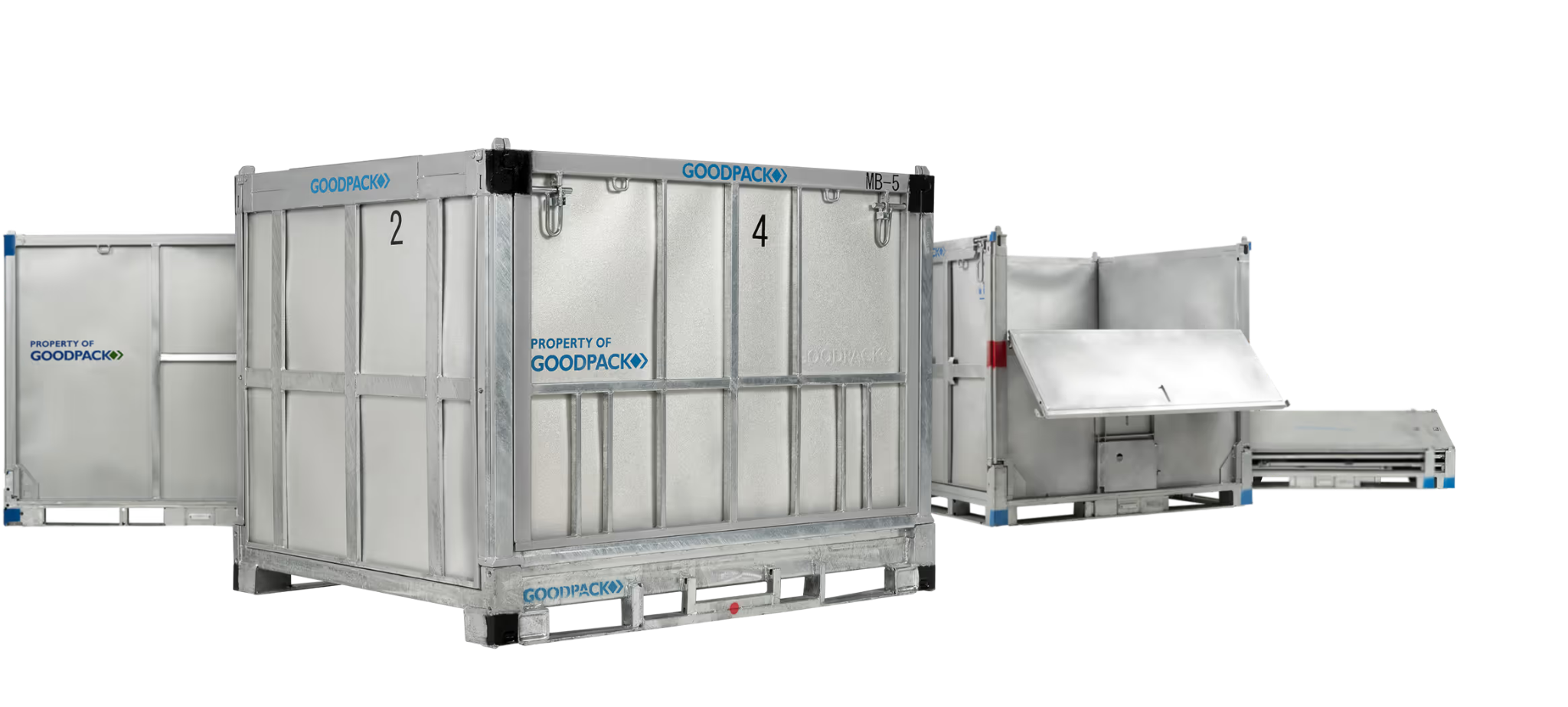
Goodpack operates in the industrial and bulk container category of this market, supplying reusable galvanized steel IBCs to rubber and tire, food and beverage, automotive, chemical and consumer goods supply chains. Our IBC rental solutions run on a global network of more than 5,000 delivery and collection points across 73 countries, this network supports the recovery and continued circulation of reusable IBCs across international supply chains.
Shifting From Packaging Ownership to Managed Access
Packaging pooling solutions reframe transport packaging as infrastructure an organization accesses rather than inventory it owns, and the consequences reach well beyond the packaging budget. Capital stops being committed to idle assets, warehouse space returns to revenue-generating use, reverse logistics becomes the provider's responsibility, and single-use waste is removed from the chain by design.
As reuse requirements evolve and businesses place greater scrutiny on packaging costs and asset utilization, pooling is becoming an increasingly relevant option within industrial packaging strategies. As reuse mandates tighten across the European Union and the cost of holding fixed assets comes under closer scrutiny, sustainable industrial container solutions delivered through a managed pool move from a niche alternative to a standard line in the procurement evaluation.
To start that conversation, tell us the routes and payloads you need covered, and explore how our managed IBC pooling model can support your supply chain.


